Glacial Waters

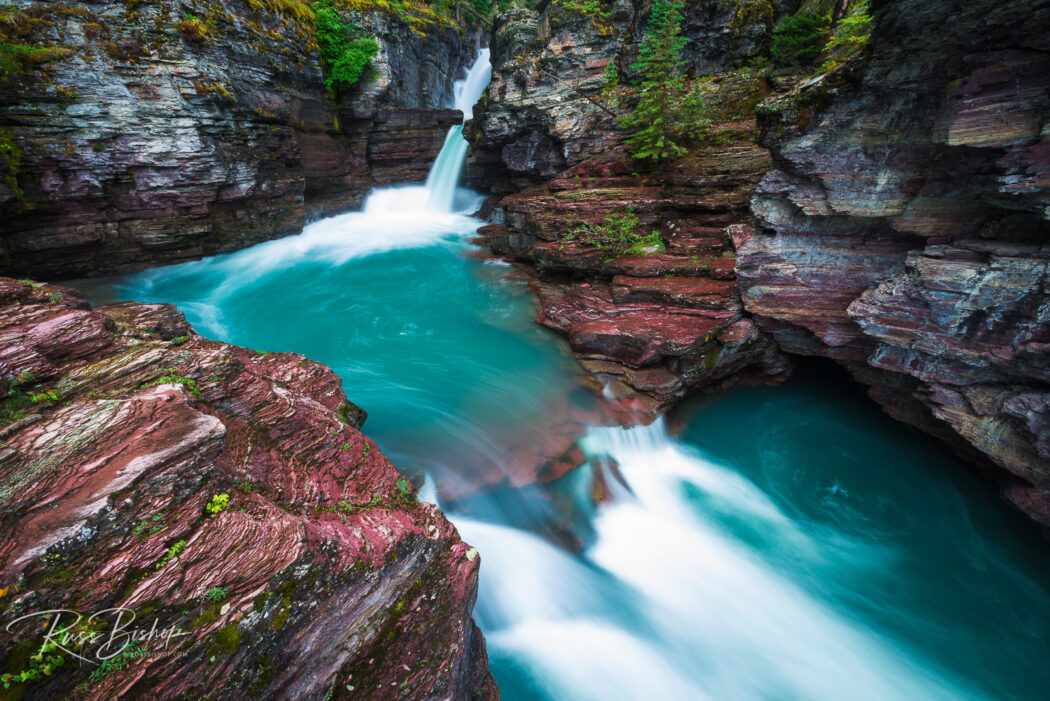
St. Mary Falls, Glacier National Park, Montana

Glacier National Park in northern Montana is a world carved by ice. Known to Native Americans as the “Shining Mountains”, canyons flow down from this alpine environment along the Continental Divide that were formed a millennia ago when mastodons roamed the earth.

Moving just inches a year, the glaciers fill the rivers and streams below with silt giving them their unique turquoise hue. And set against the red and green sedimentary rock (the oldest in the entire Rocky Mountain chain), the colors provide a visual feast while the chill in the air is a constant reminder that the ice is not far above.

Glacier is recognised as an International Biosphere Reserve and World Heritage Site, and preserves more than a million acres of forests, alpine meadows, lakes, rugged peaks and glacial-carved valleys. Though evidence shows that within thirty years all of the ice may be gone, rangers are quick to point out that the park was named as much for the forces that formed it as the glaciers themselves.

A trip to this magnificent park should be on anyone’s bucket list to North America, but it’s frozen remains are just one facet of the many awe-inspiring sights waiting to explored.


©Russ Bishop/All Rights Reserved

Soft Water

Lower Calf Creek Falls, Grand Staircase-Escalante National Monument, Utah

Shooting water in all its endless variety is one of the creative pleasures of nature photography. From drops of dew reflecting a crisp autumn morning to the power of cascading falls frozen in time, the camera allows many unique perspectives of our most abundant resource that are seldom seen in a passing glance.

A polarizing filter is a favorite tool for photographing water as it slows exposure and increases contrast, both of which serve to enhance the emotional response to a scene. While some may say this is altering reality, it’s good to remember that art is more about personal expression than documentation.

“Most creative photographs are departures from reality and it seems to take a higher order of craft to make this departure than to simulate reality.” ~Ansel Adams

This image of Calf Creek Falls in the Grand Staircase-Escalante National Monument was made on an overcast day with a long exposure of 20 seconds. The cloudy sky diffused the harsh mid-day light and saturated the colors of the moss covered rock, while the slow shutter speed gave the falls a silky look.

©Russ Bishop/All Rights Reserved

Horsetail Fall

Evening light on Horsetail Fall, El Capitan, Yosemite National Park, California
Evening light on Horsetail Fall, Yosemite National Park, California

Every February something special happens in Yosemite Valley if the conditions are right. At some point during the month the setting sun aligns perfectly with the canyon walls to the west for several evenings creating a longer than usual glow on the granite walls. And if the winter snowpack is substantial and the temperature warms enough to start the spring runoff, a wonderful cascade forms on the southeast side of El Capitan aptly named Horsetail Fall.

Of course all of this along with the rest of Yosemite’s splendor would be enough to satisfy anyone visiting the valley this time of year. But in addition (as if mother nature is trying to outdo herself) for only a few minutes each evening the alignment of the sun also illuminates the falls from behind creating a brief firefall that is truly amazing. When I made this image, the sky had been rather drab all day and as the magic time approached it looked as if nothing would happen. Then suddenly the clouds parted to the west, the falls began to glow and I had only moments to make a couple of exposures before the light was gone.

©Russ Bishop/All Rights Reserved