Hawaii’s Valley of the Kings

Hawaii's Valley of the Kings. Waipio Valley, Hamakua Coast, The Big Island, Hawaii
Waipi’o Valley, Hamakua Coast, The Big Island, Hawaii

Tucked away on the remote Hamakua Coast of The Big Island, Hawaii’s Valley of the Kings preserves the essence of ancient Hawaii. From its black sand beach, dramatic cliffs, and waterfalls to the scattering of taro farms that have worked this land for generations, this idyllic valley is a wonderful place to explore and photograph.

The overlook at the end of Highway 240 provides sweeping views of the valley below, but the adventurous traveler will want to experience this verdant valley up close. The excitement starts as you leave the overlook and descend the 25% grade, taxing both engines and muscles alike. This paved public road, which is only open to 4-wheel drive vehicles and foot traffic, is the steepest road of its length in the United States and possibly the world.

Waipiʻo means “curved water” in the Hawaiian language and aptly describes the lazy river that greets you at the bottom. Wild horses can often be seen wandering along its banks, and this is a good spot to bring a kayak and explore upstream. Heading towards the Pacific the road ends at the beach and a primitive picnic area, but you can cross the river when the water is low and experience your own piece of paradise a la Robinson Crusoe. The black sand beach to the west is usually deserted and the occasional washed up fishing float or Hawaiian offering amid the coconut palms provide a truly remote feeling.

It’s easy to see why this was a favorite spot of the ancient Hawaiian royalty, and you might remember it as the final scene in Kevin Costner’s sci-fi epic Waterworld. When it’s time to leave, your only regret is that first glimpse of the road back to reality.


©Russ Bishop/All Rights Reserved

Fall Color Photography – Where’s The Light?

Fresh snow on fall aspens and pines, Inyo National Forest, California USA

Fall Color Photography – Where’s The Light? Successful fall color photography obviously starts with planning around the seasonal changing of the leaves (and this Fall Color Map can help), but once you’ve scouted your location there’s another key factor to consider.

Where and how the color happens is dependent upon elevation and temperature and no two years are ever the same. The higher mountains of the west begin in mid-September, eastern hardwoods in October, and the lower red-rock country of the southwest typically in early November. Once you’ve settled on a destination and found that great grove of trees the next step is to understand the light.

It might seem like the vibrant reds or yellows before you would be faithfully reproduced by your sensor no matter what time of day, but understanding the quality of the light can go along way towards guaranteeing your success. Using backlight or sidelight when the sun is low on the horizon and illuminates the leaves from behind creates a wonderful warm glow, especially when set against a dark background.

Softlight is another great light source (illustrated above) that occurs when the sky is overcast and acts like a giant studio softbox. Under these conditions, it doesn’t matter what time of day you’re shooting as the shadows are eliminated and the uniform light both reduces the contrast while intensifying the colors.

So when the scene presents itself, consider the light and framing, and don’t be too quick to trip the shutter. A slight change in position or a little patience can often make the difference between a good image and a great one.


©Russ Bishop/All Rights Reserved

The Fire Within

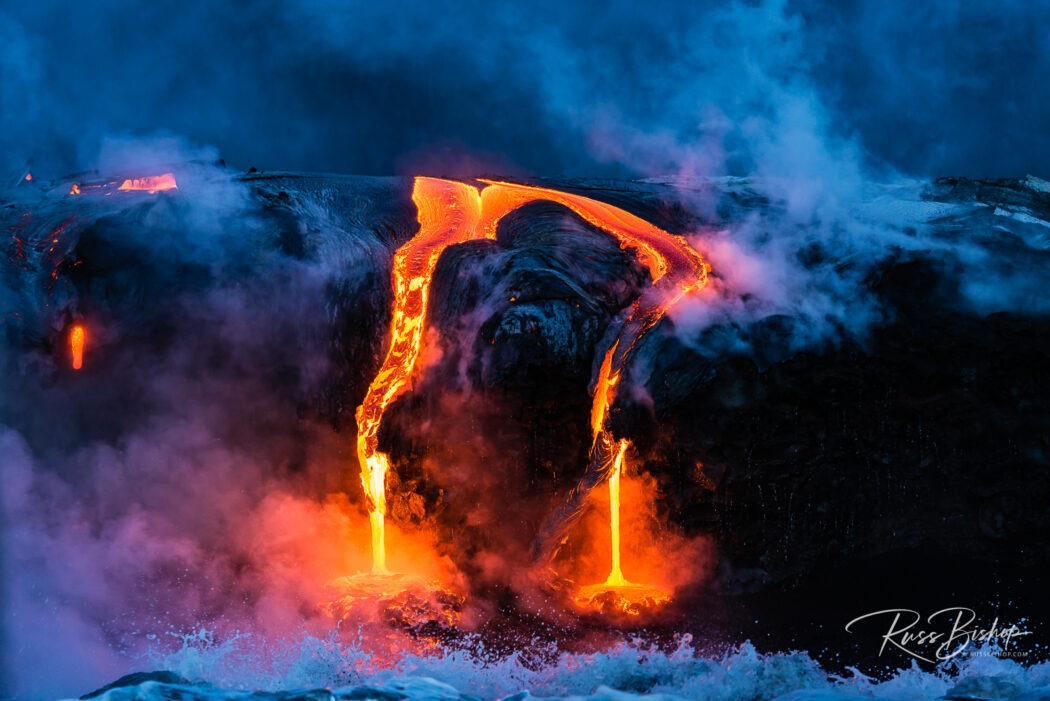
The Fire Within - Lava flow entering the ocean at dawn, Hawaii Volcanoes National Park,, Hawaii
Lava flow entering the ocean at dawn, Hawaii Volcanoes National Park, Hawaii

The Fire Within. For more than a quarter century Madame Pele the goddess of fire has let her temperament be known on the Big Island of Hawaii. Often without warning she has re-awakened many times during a forty-year period sending a river of lava flowing into the sea and creating one of the most active volcanoes on earth.

This image made in the pre-dawn hours in Hawaii Volcanoes National Park shows the raw force of fire and water combining to form new land. It is an incredible spectacle to witness and one of the most challenging subjects I have ever photographed.

For many years walking across miles of a’a lava fields (the sharp brittle variety) in the dark and carefully setting up a tripod on a newly formed shelf above the sea was the only option. But when the lava began flowing into the sea an off-shore view provided a new perspective to this ever-changing landscape.

In stark contrast to shooting the lush forests and beautiful beaches on the windward side of this same island, this is a land of raw earth and fire – and beauty of a different kind. The experience is intoxicating, and once you’ve caught your first glimpse of Pele’s glow the desire to return again and again is hard to resist.


©Russ Bishop/All Rights Reserved